HyperHuman
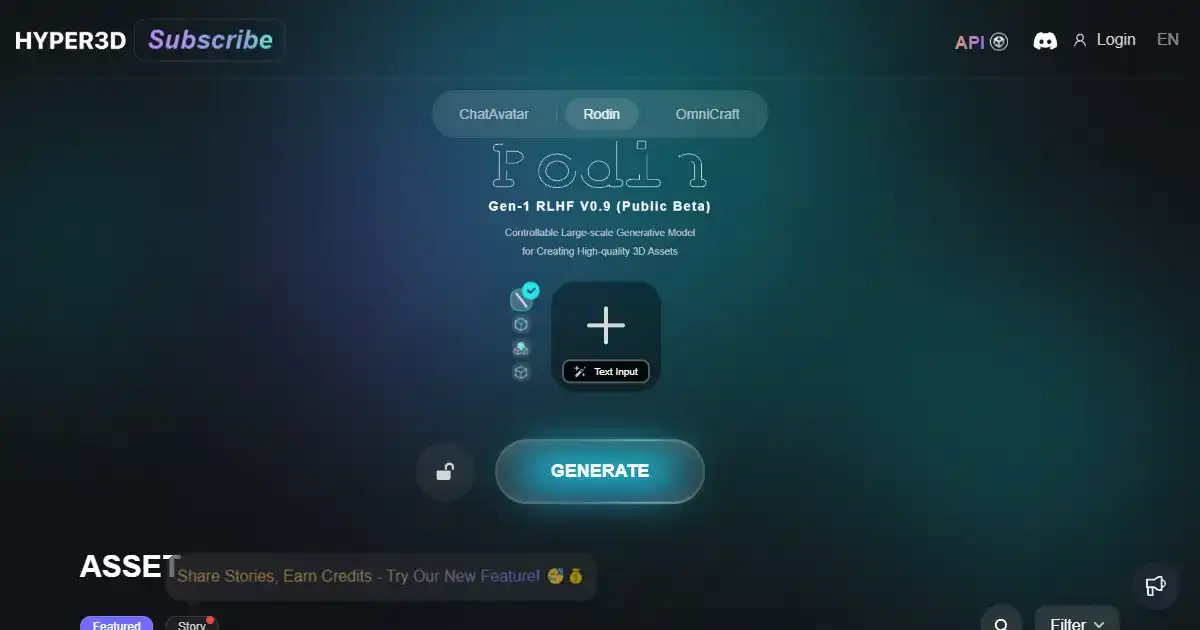
HyperHuman is an advanced AI-powered 3D face generator. Designed for animators and game developers, it creates realistic, animatable faces from text prompts. This tool integrates with industry-standard software for seamless workflow integration.
One translation. Verified by 22 AI models.
Compare leading AI translations, preserve document layouts, and add human verification when accuracy matters.
From idea to 3D model in one browser workspace
Generate from text or images, inspect the result online, then export GLB or OBJ and continue toward an STL workflow.

Create more in one place
Generate images, make videos, edit photos and create audio with shared credits.
Explore MagicShotWhat is HyperHuman
HyperHuman is an advanced AI-powered tool that generates animatable 3D faces from text prompts. Designed for game developers, animators, and digital artists, it streamlines the character creation process by enabling users to describe the desired facial features and expressions in natural language. Its integration with leading software like Blender, Unreal Engine, Unity, and Maya provides a seamless workflow for bringing these 3D models into established production pipelines. The ability to quickly generate high-quality, animation-ready faces reduces development time and enables greater creative exploration within character design.
Key Features of HyperHuman
A state-of-the-art AI tool empowering game developers, digital artists and animators to streamline the character design process. Easily produce, refine, customize, then integrate 3D generated faces with industry-standard software. It helps turn a usually arduous task into an almost instantaneous one.
Text-Based 3D Face Generation: Create 3D faces using descriptive text prompts, simplifying the character design process.
Animation-Ready Output: Generate faces optimized for animation in real time, speeding up prototyping and animation workflows.
Software Integration: Compatible with software such as Blender, Unreal Engine, Unity, and Maya, facilitating seamless integration into various projects.
Realistic Facial Features: Produces 3D faces with nuanced features and lifelike expressions.
Customizable Faces: Refine and personalize generated faces based on specific artistic preferences, or iterate within Hyperhuman until the match is perfect
Use Cases of HyperHuman
Game Development: Creating realistic and expressive character models for video games.
Animation: Generating detailed facial models for animated films and shorts.
Virtual Reality (VR) and Augmented Reality (AR): Developing avatars and characters for immersive experiences.
Digital Art: Producing unique and detailed facial art pieces.
Film and Media: Streamlining production of realistic digital doubles or facial prosthetics for actors, replacing complex procedures traditionally used in post-production.
Medical Visualization: Facial reconstructions using data-driven analysis as required in criminal justice procedures when only parts of a subject’s skeleton or remains have been recovered, and not all of it
HyperHuman Pros and Cons
Pros
- Significant time savings compared to manual 3D face modeling, accelerating workflows for rapid prototyping.
- Simplifies the generation of detailed expressions and precise features based on user text commands
- Accessibility within commonly used game development environments through software integration increases deployment simplicity and value.
- Easy exploration of creative possibilities during character ideation, facilitated by iterative refinement using adjustable prompts in generating and experimenting on faces
Cons
- Potential learning curve for effective prompt crafting to obtain optimal face details
- Dependence on computing resources might arise if many iterations or complex output requirements exist
- Subscription cost could vary based on user level such as freelancer, indie company or big studio, causing additional budget concerns
- The creative direction ultimately depends on available algorithmic capacity in meeting specific user demands
HyperHuman FAQs
How does HyperHuman work?
HyperHuman uses advanced AI algorithms to interpret text prompts and generate corresponding 3D faces. It leverages a deep understanding of facial features and expressions to create realistic and animatable models.
What software is compatible with HyperHuman?
HyperHuman is designed to integrate with popular 3D modeling and animation software like Blender, Unreal Engine, Unity, and Maya, streamlining the workflow for incorporating generated faces into existing projects.
Who is HyperHuman intended for?
While primarily targeted towards game developers and animators, HyperHuman can be utilized by anyone interested in creating realistic 3D faces, such as digital artists, filmmakers, and VR/AR developers.
Interested in this product?
Take a look at their websiteUpdated 2026-10-05
Find More Tools

Learna AI is a comprehensive English learning app using AI for grammar, speaking, reading, pronunciation, and vocabulary, and includes personalized virtual tutoring.

Cursor101 is a dedicated learning hub offering tutorials, insights, and guides for developers looking to enhance their workflows with Cursor, an AI-assisted code editor built on VSCode.
Human or Not? is an engaging AI-powered game. In a timed chat, players determine if their partner is human or AI.

Alaya AI is a decentralized AI data platform that combines data collection, labeling, and social commerce to deliver high-quality, scalable data for the AI industry while protecting data ownership and privacy.

Gauth (formerly Gauthmath) is an AI-powered app offering instant solutions and explanations for math and other STEM subjects. It uses photo recognition, AI algorithms, and live expert tutors.

NovelAI is a subscription service offering AI tools for creative writing, storytelling, and image generation. It uses customizable models and has no censorship.